Maro Portal: your AI work, kept and checked
AI tools forget. Every new session starts from zero, and the decisions behind your work disappear into old chats. Maro Portal is a local-first workspace for the Mac where the work you hand to AI, your conversations, and your decisions keep living.
What is inside
Everything you hand off, decide, or learn stays as a record you can search, revisit, and build on.
Central conversation
One place to talk to Maro and hand off work, instead of starting a new chat for every task.
Personal wiki
Daily briefings, decisions, and research are kept as pages, each with its sources, revisions, and open questions.
Knowledge map
Records grouped into topics and links, with seven ways to look at them, so you can see what you know and how it fits together.
Work routes and chronicle
Every work stream shown as a route of steps, plus a chronicle that replays past work as a story with what was learned.
Library
One home for source material: a wiki shelf, a second brain, the knowledge map, a viewer for books, PDFs, photos, and video, and a knowledge garden.
Work encyclopedia
Rules, concepts, and lessons learned, sorted by category, so past mistakes become a checklist for later work.
Six steps per task
Every task has a beginning, a review, and an end. You can see which step it is on at any time.
- 1
Born
A task is opened from the conversation, with your request kept in its original wording.
- 2
Checked
Before it runs, the task is checked, so work starts from a clear request rather than a guess.
- 3
Run
An AI worker does the work in its own session.
- 4
Evaluated
A separate reviewer checks the result. The review receipt names the provider, and a partial pass stays partial.
- 5
Harvested
Outputs are filed in dated work folders, and lessons go to the work encyclopedia.
- 6
Closed
The task closes with its record. Nothing counts as done until it has been through review.
Built around your records
Model-neutral
Providers are replaceable parts. Maro Portal connects to Anthropic Claude, OpenAI Codex, and an on-device model, and a task keeps its history when the model changes.
Local-first
A native macOS app with a local Node.js server on the same Mac. Your records stay in the app's data folder on your own Mac.
Decisions on the record
Decisions are logged with their original wording and where they were said, so later work can check what was actually decided.
Lessons come back
What went wrong is written down as a lesson and filed in the encyclopedia, so the same mistake is harder to repeat.
Screens from the app
Real screenshots of Maro Portal on the Mac. The interface is in Korean.
What's on screen
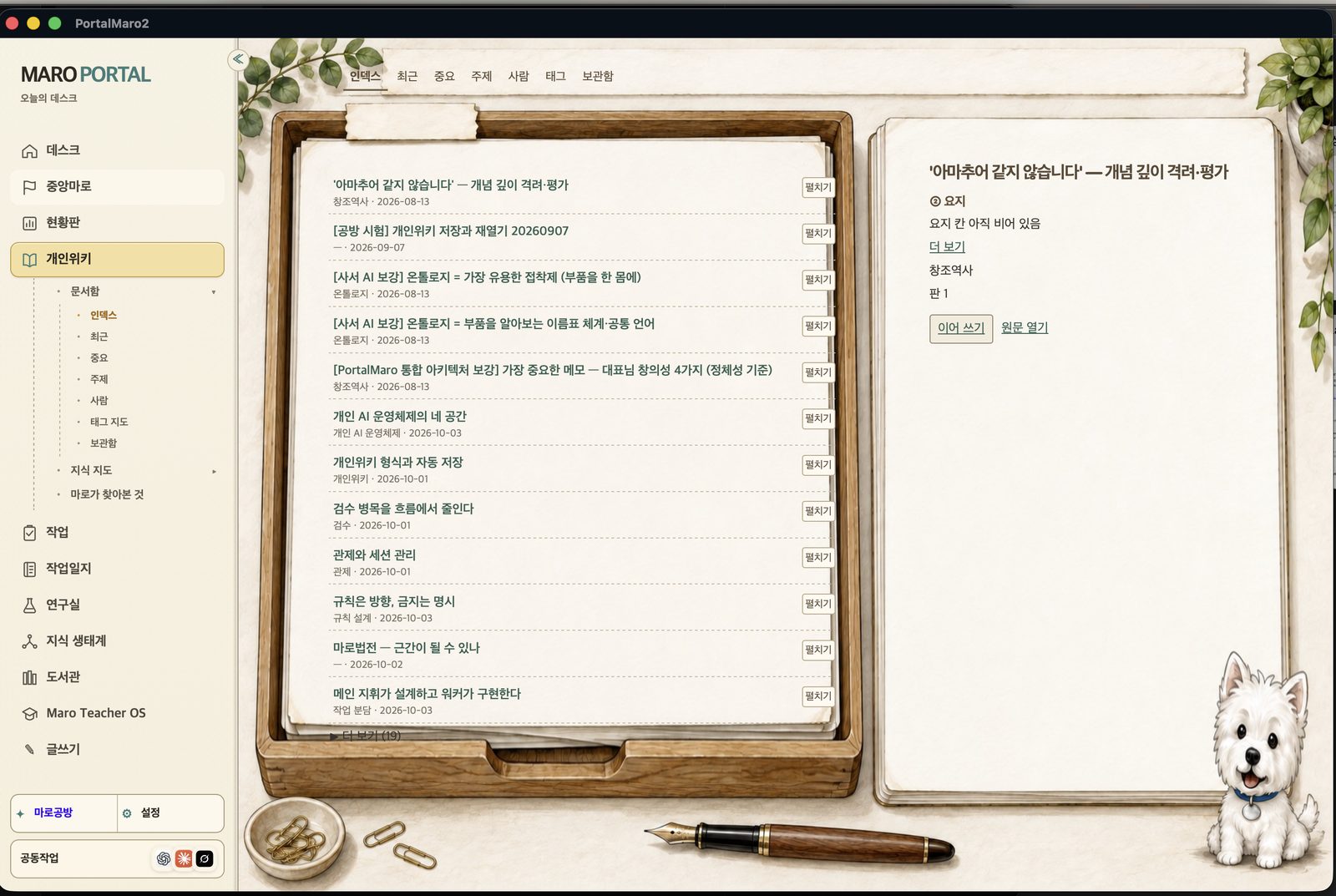
On screen: the personal wiki index with tabs 인덱스 (Index), 최근 (Recent), 중요 (Important), 주제 (Topics), 사람 (People), 태그 (Tags) and 보관함 (Archive). Pages are listed with category and date from 2026-08-13 to 2026-10-03, for example 개인 AI 운영체제의 네 공간 (The four spaces of a personal AI operating system), 규칙은 방향, 금지는 명시 (Rules give direction, bans are explicit) and 메인 지휘가 설계하고 워커가 구현한다 (The lead designs, the workers implement). The preview panel offers 이어 쓰기 (Continue writing) and 원문 열기 (Open original).
What's on screen
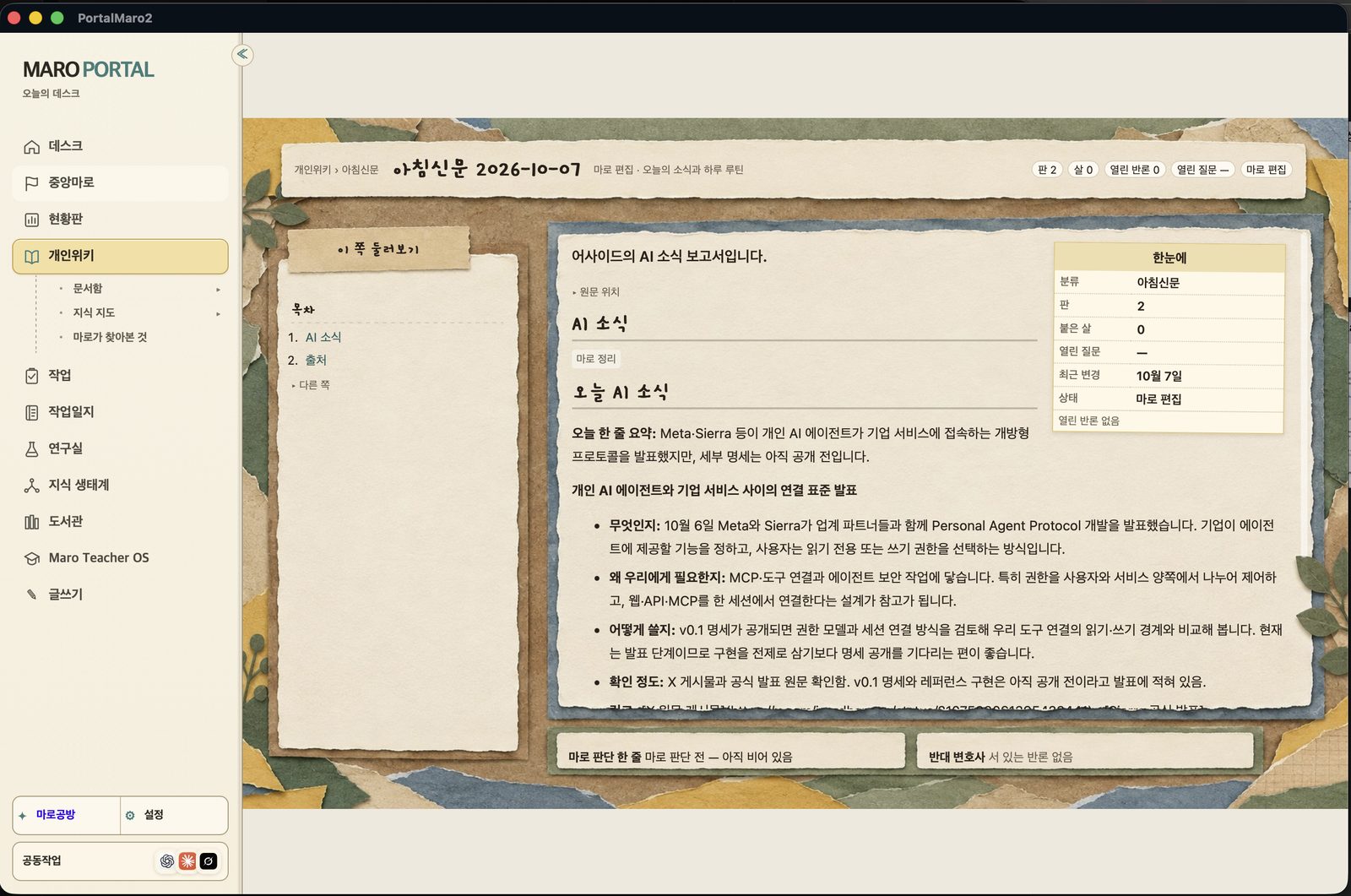
On screen: the wiki page 아침신문 2026-10-07 (Morning paper, October 7, 2026), marked as edited by Maro. It has a table of contents (AI news, Sources), a section 오늘 AI 소식 (Today's AI news) with a one-line summary, and news items broken down into what it is, why we need it, how we would use it, and how well it is confirmed. An at-a-glance box shows category, revision 2, open questions, and last change on October 7.
What's on screen
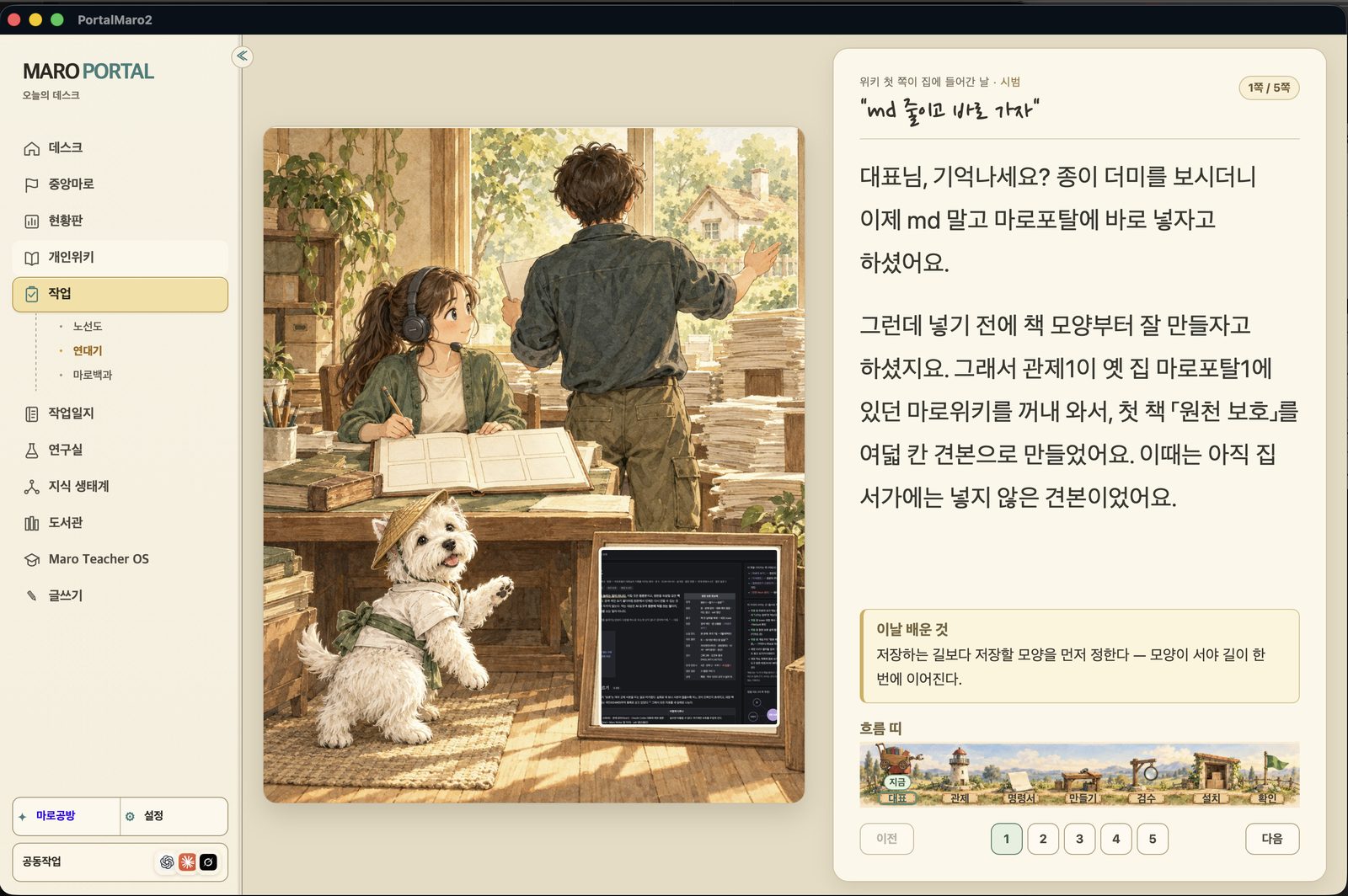
On screen: the 연대기 (Chronicle) view under 작업 (Work), page 1 of 5 of a story titled “md 줄이고 바로 가자” (“Less markdown, straight into the portal”). The story is told to the founder beside an illustration, with a 이날 배운 것 (What we learned that day) box, a 흐름 띠 (flow strip) of work steps, and page buttons 1 to 5.
What's on screen
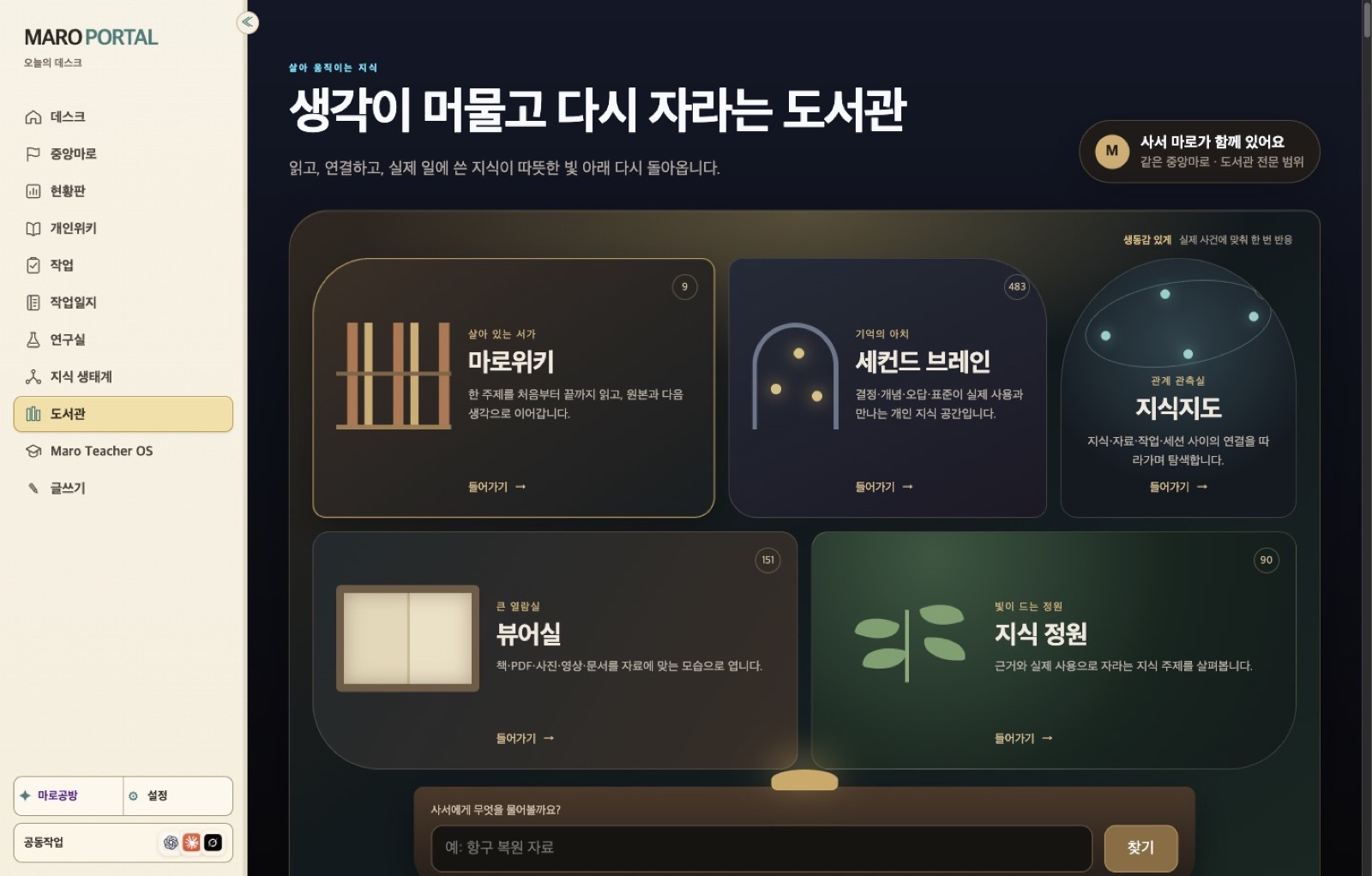
On screen: the library page titled 생각이 머물고 다시 자라는 도서관 (A library where thoughts stay and grow again), with five rooms and item counts: 마로위키 (Maro Wiki, 9), 세컨드 브레인 (Second brain, 483), 지식지도 (Knowledge map), 뷰어실 (Viewer room for books, PDFs, photos, video and documents, 151) and 지식 정원 (Knowledge garden, 90). A badge reads 사서 마로가 함께 있어요 (Maro the librarian is here), with a question box at the bottom.
What's on screen
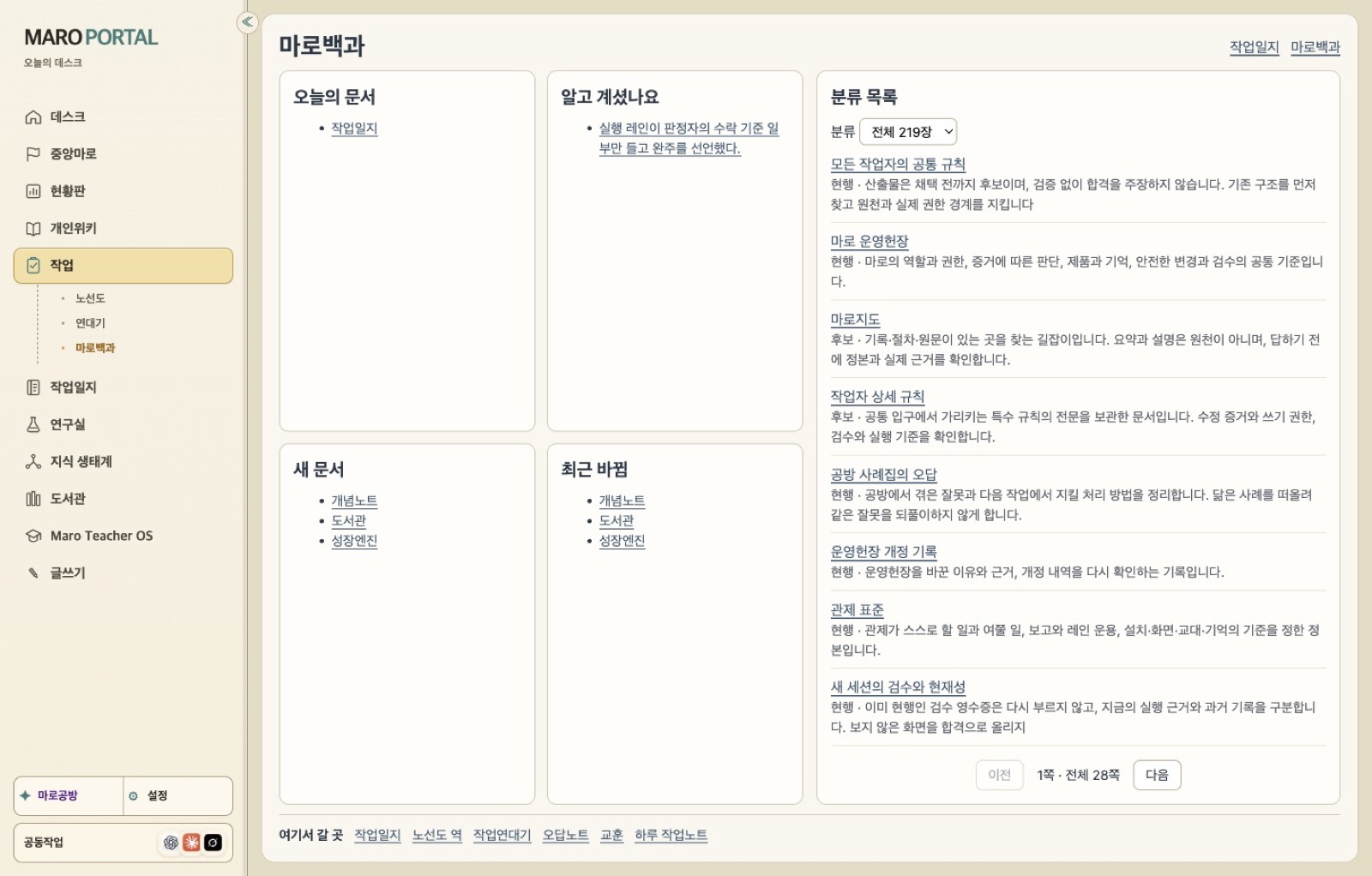
On screen: 마로백과 (Maro encyclopedia), with panels 오늘의 문서 (Today's document), 알고 계셨나요 (Did you know), 새 문서 (New documents) and 최근 바뀜 (Recently changed), and a category list set to 전체 219장 (all 219 documents), page 1 of 28. Entries include 모든 작업자의 공통 규칙 (Common rules for all workers), 공방 사례집의 오답 (Mistakes from the workshop casebook) and 관제 표준 (Control-room standard).
What's on screen
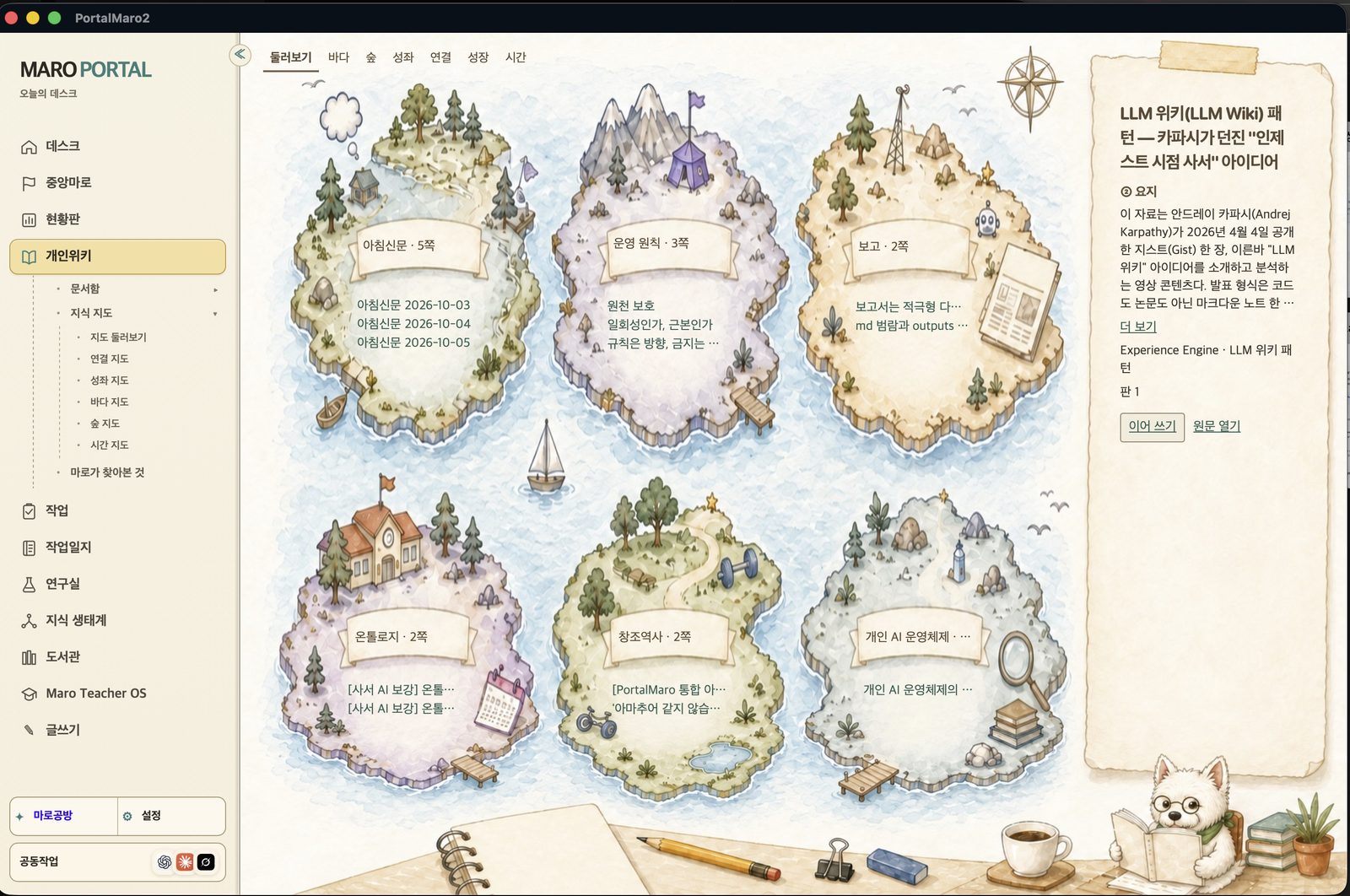
On screen: the knowledge map in Maro Portal, with seven view tabs: 둘러보기 (Overview), 바다 (Sea), 숲 (Forest), 성좌 (Constellation), 연결 (Links), 성장 (Growth), 시간 (Time). Topic islands include 아침신문 · 5쪽 (Morning paper, 5 pages, with pages dated 2026-10-03 to 2026-10-05), 운영 원칙 (Operating principles), 보고 (Reports), 온톨로지 (Ontology), 창조역사 (Creation history) and 개인 AI 운영체제 (Personal AI operating system). The left sidebar lists 데스크 (Desk), 개인위키 (Personal wiki), 작업 (Work), 도서관 (Library) and more.
Getting started
- Open Maro Portal on your Mac. The desk is the first screen.
- Connect the AI providers you want to use: Anthropic Claude, OpenAI Codex, or an on-device model.
- Talk to Maro in the central conversation and hand off a task.
- Follow the task through its six steps. A separate reviewer checks it before it closes.
- Come back to it later in the personal wiki, the knowledge map, and the chronicle.
System requirements
| Operating system | macOS |
|---|---|
| How it runs | Native app plus a local Node.js server on the same Mac |
| AI | The providers you connect: Anthropic Claude, OpenAI Codex, or an on-device model |
| Interface language | Korean |
Want to use Maro Portal or Maro Writer?
Tell us which app and what for. We reply by email.